

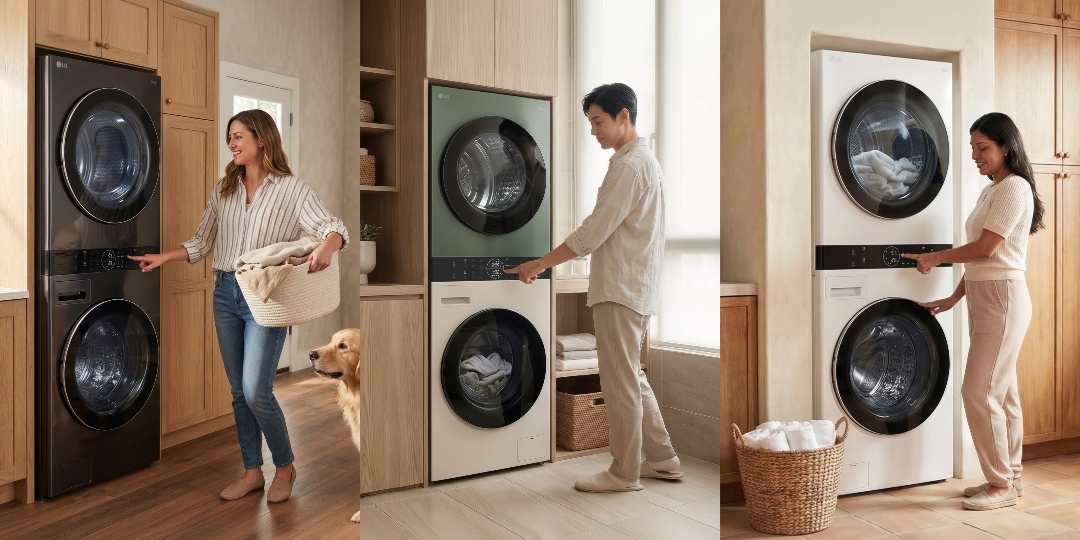
Most homes solve the laundry space problem the same way: a washer here, a dryer stacked or standing beside it, two separate machines that happen to sit in the same room. LG’s approach to that problem was to stop treating them as two machines at all.
One Body, Two Jobs
The WashTower combines a washer and dryer into a single unibody design, rather than two appliances stacked on top of each other. LG frames the design around what it calls the 3S concept, space, style and smart technology, aiming for a unit that fits into an ordinary home’s footprint without giving up washing or drying capacity.
Regional press materials describe a washer capacity of 13 kilograms paired with a 10-kilogram dryer, needing less installation space than a stackable or side-by-side pair of comparable capacity.
For context, LG’s general guidance for the region places 9kg machines as suited to a family of three to four, with 11 to 12kg models aimed at larger households or those doing frequent loads, putting the WashTower’s washer capacity comfortably above what most households would need, built more for volume and frequency than for a small flat.
All LG washing machines share a standard 600mm width and 850mm height, with depth varying between 565mm and 675mm depending on drum size, so the WashTower’s footprint is predictable even before capacity is factored in.
A Machine That Reads the Laundry
The washing side runs on AI DD, LG’s term for Artificial Intelligence Direct Drive, which analyses the weight and fabric type of each load individually and adjusts the washing motion accordingly, rather than applying one fixed cycle regardless of what’s inside. The result, according to LG, is better fabric protection and clothes that hold their appearance for longer. Underneath that intelligence sits LG’s Direct Drive motor, which uses six-motion technology with fewer moving parts than a conventional belt-driven motor, a design aimed at durability and lower energy use as much as wash performance.
Everything Can Wait: Spain and Belgium Set for Quarterfinal Showdown
The same intelligence extends to the wash-dry handoff: a Smart Pairing feature syncs the dryer to the washer automatically, selecting an appropriate drying cycle based on what load setting was used for the wash, without someone needing to choose it manually.
Washing speed comes from a feature called TurboWash360, aimed at cutting cycle times without compromising the clean, while drying is handled by a Dual Inverter Heat Pump system, working on the same basic principle as a hairdryer paired with a dehumidifier, intended to dry clothes gently while using less energy than a standard heating-element dryer.
Controls Built for How People Actually Reach Them
One detail LG has been particularly vocal about is control placement. Conventional stacked washer-dryer pairs put the dryer’s controls at the very top of the unit, often above eye level, forcing shorter users to reach up or use a step stool just to start a cycle. The WashTower’s Center Control panel sits at a middle height instead, giving access to both washer and dryer controls from the same, more reachable position, a detail LG positions as unique to this design rather than shared with typical stacked units.
Cycles From the Cloud, Saved to the Machine
Through the LG ThinQ app, the WashTower can pull in what LG calls Cloud cycles, preset wash and dry combinations built for specific laundry situations rather than the fixed set that ships with the machine. Anyone who finds themselves using a particular combination often can save it directly onto the machine as a Download cycle, turning a one-off app setting into a permanent option on the control panel itself.
A Machine Built to Outlast the Average
Most washing machines last somewhere between seven and twelve years, with ten years being a fairly typical lifespan. LG backs the WashTower’s moving parts to roughly that same horizon: a ten-year warranty covers the washer’s Direct Drive motor and the dryer’s Dual Inverter compressor and motor, the two components most likely to wear out well before the rest of the appliance does. It’s a warranty length that, in effect, tells a buyer the manufacturer expects the machine to still be running motor-first a decade in, rather than needing a replacement part halfway through its expected life.
The Big Change
None of this changes what laundry fundamentally involves: dirty clothes going in, clean dry clothes coming out. What it changes is how much floor space, and how much manual cycle-matching, that process demands of a household. A single unit instead of two, a dryer that already knows what the washer just did, controls placed where an actual person can reach them without a step stool, and a warranty that backs the machine for roughly as long as it’s expected to last, that’s a fair list of improvements.