
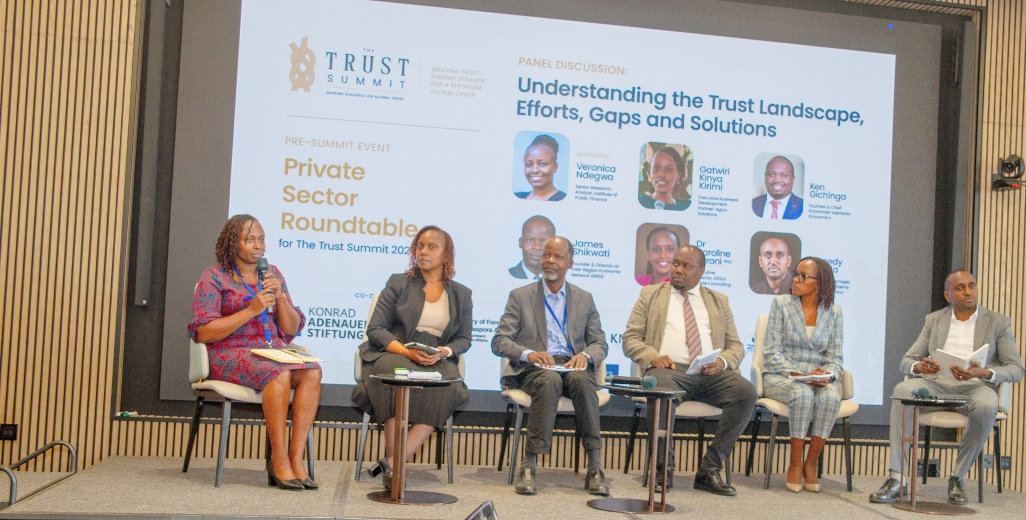
NAIROBI, Kenya, 18 August 2026: Kenya’s private sector engaged directly today at a high-level Private Sector Roundtable to examine how stronger trust between institutions, businesses and citizens can support investment, regional trade, digital commerce and economic resilience, as the country prepares to host the inaugural Trust Summit in Nairobi this October.
The roundtable, convened under the theme “Trust as an Economic Asset: Strengthening Public-Private Dialogue, Regional Economic Cooperation and Digital Trust for Market Resilience and Sustainable Growth,” brought together key private sector voices to examine trust as a driver of investment, market confidence and regional competitiveness, and to preview the concrete outputs the Trust Summit is designed to deliver.
The discussions placed the private sector at the centre of a broader question facing economies globally: how can trust be rebuilt in institutions, markets and systems at a time of economic uncertainty, geopolitical tensions and rapid technological change?
Delivering the keynote address on behalf of Dr. A. Korir Sing’Oei, Principal Secretary, State Department for Foreign Affairs, Mr. Mustafa Ibrahim, Deputy Director-General and Head of the Policy, Research and Strategic Analysis Directorate, said trust must be treated as a critical economic asset influencing investment, access to finance, business confidence, trade and Kenya’s long-term competitiveness.
“We meet at a time of considerable headwinds in the global economy. Confidence in institutions has come under strain, economic uncertainty has risen, geopolitical tensions persist, and rapid technological change is reshaping how governments, businesses and citizens interact,” he said, adding that building trust was a shared responsibility: government must provide a stable, predictable policy environment, while responsible corporate governance and ethical leadership within the private sector remain essential to attracting investment, expanding markets and driving innovation.
Four documents you need to have to win government, private sector tenders
Opening the discussion on the economic dimensions of trust, Prof. XN Iraki, Faculty of Business and Management Science, University of Nairobi, highlighted the direct cost of low trust to businesses and investors.
“When people trust each other, businesses spend less on contracts, audits, and security, and can charge more without losing customers. Investors show up too. But when trust breaks down, everyone pays for it: higher interest rates, more red tape, slower growth,” he said.
Mathias Kamp, Country Director, Konrad-Adenauer-Stiftung (KAS) Kenya Office and co-convener of the Trust Summit, broadened the discussion to the relationship between trust, investment and the wider economic environment, noting that infrastructure and investment can only deliver their intended impact when supported by trusted institutions and businesses.
“Trust is a prerequisite for investment and economic growth. You can invest heavily in infrastructure, but if the institutions and businesses operating within it are not trusted, the infrastructure alone will not deliver the outcomes we expect,” he said.
For Ms. Lucy Muchoki, Partnership Director, Kenya National Chamber of Commerce and Industry (KNCCI), the discussion must now move from recognising the value of trust to identifying the practical steps required to strengthen it.
“Trust is not simply about reputation; it has direct economic value. Let us move beyond simply agreeing that trust matters. Let us identify what needs to change and commit to where partnerships are required,” she said.
The Roundtable, held in partnership with the Kenya Private Sector Alliance (KEPSA), KAS, the Institute of Public Finance (IPF), KNCCI, TradeMark Africa and the COMESA Business Council, is one of the building blocks ahead of Kenya’s hosting of the inaugural Trust Summit, convened under the theme “Weaving Trust: Binding Strands for a Stronger Global Order.”
What the Trust Summit Will Deliver
Beyond dialogue, the Trust Summit is structured to produce a defined set of outputs that participants and the public can track after October. These include:
- A Nairobi Statement on Global Trust for Sustainable Development and Peace, capturing the key principles and areas of consensus reached at the Summit.
- A Trust Barometer, an active public dashboard tracking trust levels and benchmarks over time.
- A joint Trust Summit Secretariat to track, verify and report publicly on progress against the commitments made at the Summit.
- A dedicated report on Africa’s trust landscape, setting out the continent’s specific drivers of the trust deficit and priority interventions for governments, institutions and development partners.
- Policy recommendations and action frameworks, with pillar-specific, time-bound commitments and accountability mechanisms across the Summit’s thematic pillars, including international cooperation and multilateralism, democratic governance, trust as an economic asset, and information integrity in the digital age.
Together, these outputs are designed to give governments, investors, media and citizens a concrete way to hold the Summit’s commitments to account, rather than a one-off conversation about trust in the abstract.
Why It Matters Ahead of October
Confidence in governments, institutions and multilateral systems has fallen to a structural low across every region and generation. According to the 2025 Edelman Trust Barometer, global trust in government now sits at just 52 percent, while trust in business holds steadier at 62 percent, making business the only major institution worldwide currently perceived as both ethical and competent.
For low-income countries, the cost of that deficit is measurable: recent research cited in the Summit’s concept note finds these countries receive less than one percent of global foreign direct investment despite having the greatest need for productive capital, while African nations pay an estimated USD 75 billion in additional interest annually as a result of risk premiums tied to perceptions of institutional trust.
It is this widening gap that the Trust Summit is designed to address, delivering on the United Nations’ 2024 Pact for the Future commitment to rebuild trust in global institutions.
For Kenyan business leaders, it also represents an opening as the country positions itself as a convener of global economic and diplomatic dialogue.
Notes to Editors
About the Trust Summit 2026
The inaugural Trust Summit: Nairobi Dialogues on Global Trust will convene in Nairobi, Kenya on 21-23 October 2026, bringing together global leaders, policymakers, business, academia, civil society, media and young people to address one of the defining challenges of our time: rebuilding trust as the foundation of effective governance, resilient societies, inclusive economies and international cooperation.
The inaugural convening launches the Nairobi Dialogues on Global Trust as a global platform for dialogue, partnership and collective action. It will produce a Nairobi Statement on Global Trust, a Summit Outcome Report, a Trust Barometer dashboard, a joint task force to track and verify follow-through, a dedicated report on Africa’s trust landscape, and pillar-specific policy recommendations and action frameworks.
The Summit is convened by the Ministry of Foreign and Diaspora Affairs (State Department for Foreign Affairs), the Executive Office of the President (Office of the Chief of Staff and Head of the Public Service), the Open Government Partnership, Strathmore University, UNDP Kenya, the Ford Foundation and Konrad Adenauer Stiftung, in partnership with the Institute of Public Finance (IPF).