
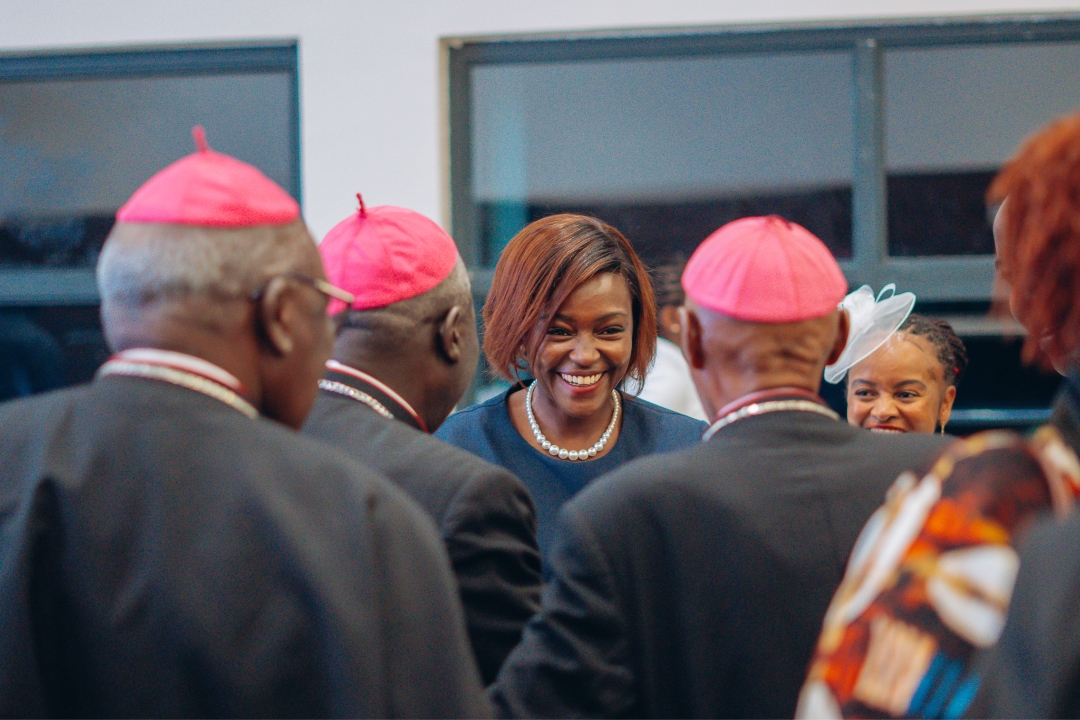
Ecobank Kenya has affirmed its commitment to support Catholic institutions that drive social and economic development by partnering with the Association of Member Episcopal Conferences in Eastern Africa (AMECEA). Ecobank says this will enable the institutions to improve their operational efficiency while focusing on their mission of serving communities and improving livelihoods across the region.
Speaking during the welcome dinner ahead of the 21st AMECEA Plenary Assembly in Nairobi, Ecobank Kenya Managing Director, Ms. Rebecca Mbithi said the Bank’s sponsorship of the Assembly reflects a broader commitment to partnering with institutions that are shaping Africa’s future.
“While the Church and Ecobank fulfil different mandates, we are both stewards of purpose-driven institutions that exist to serve people, strengthen communities, and contribute to Africa’s development. It is this shared commitment to service, impact, and community advancement that makes our partnership with AMECEA both natural and deeply meaningful,” said Ms Mbithi.
As of 2020, Catholic institutions across Africa collectively served close to 100 million people through the education sector, including communities within the nine Eastern African countries represented by AMECEA. Ecobank, which has a presence in 34 African countries, currently operates in seven of the nine countries represented within AMECEA. This cross-border presence provides a strong platform for Ecobank to support Catholic institutions whose ministries increasingly extend beyond national boundaries.
Safaricom chapa dimba kicks off fifth edition with record 3,178 teams
“Our role is to help deliver impact. We aspire to be the trusted financial partner that enables mission-driven institutions to focus on changing lives, while we support the systems that allow them to operate efficiently.” added Ms Mbithi.
The 21st AMECEA Plenary Assembly has brought together bishops and delegates from Kenya, Uganda, Tanzania, Ethiopia, Eritrea, Malawi, Zambia, Sudan, and South Sudan for prayer, reflection, dialogue and strategic dialogue on the future of the Church in Eastern Africa. The 2026 Assembly will place particular emphasis on youth mentorship, peacebuilding, and governance.
In Kenya, the Catholic Church is the country’s largest non-state provider of healthcare and education services. Through a vast network accounting for a quarter of the nation’s healthcare infrastructure, it operates close to 500 health facilities, including 69 hospitals, 117 health centres, 22 medical training colleges, 251 dispensaries, and more than 46 community-based health units. It sponsors over 31 percent of the country’s learning institutions, anchoring a massive academic footprint of more than 8,000 primary and secondary schools alongside 2,500 Early Childhood Centres, 3 universities, 21 Teacher Training Colleges, 14 medical training colleges, and approximately 200 Vocational and Technical (TVET) institutions.