

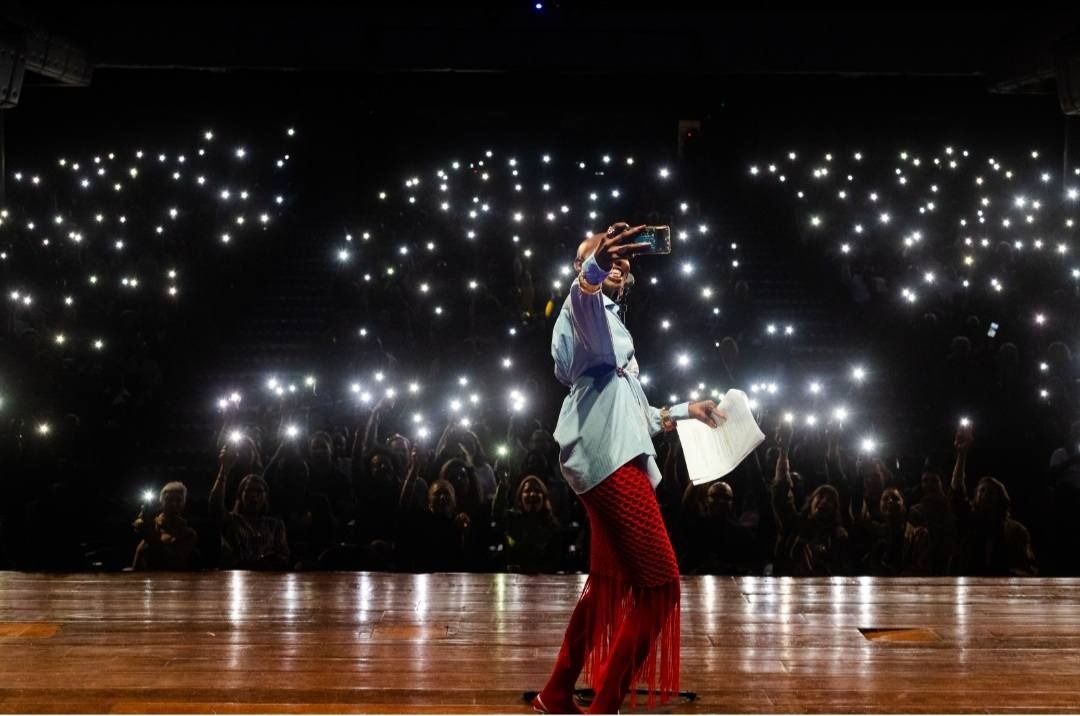
NAIROBI, Kenya — The Moth, the world-renowned nonprofit dedicated to the art of live personal storytelling, returns to Nairobi on Saturday, 7 November 2026, for its seventh Mainstage event in the city, once again hosted by Kenyan media entrepreneur and women’s rights advocate Adelle Onyango.
Staged at the Catholic University of Eastern Africa’s LRC Auditorium, the evening will bring together five storytellers from Kenya, Uganda, Nigeria and Sierra Leone, Anne Obure, Shakirah Namwanje, Odun Orimolade, Bernard Mbugua and Mahmood Bangura, who will share true, personal stories live and without notes.
This year’s Nairobi Mainstage is built around the theme NOW OR NEVER: true stories of taking chances, of throwing caution to the wind and making your move, of walking the tightrope determined not to look down, and of having the audacity to say that today is the day everything changes. The theme carries particular weight in Nairobi this year, as five storytellers speak, in very different registers, about moments when waiting was no longer an option, and about some of the sharpest edges that Kenyans and their neighbours across the continent are living with today.
FIVE STORIES, FIVE MOMENTS OF NOW OR NEVER
Shakirah Namwanje, founder of the WOMANDLA Foundation Uganda and an HIV and sexual and reproductive health rights advocate, will share a personal story of confronting an HIV diagnosis while holding on to her dream of becoming a mother. Her story arrives against a stark backdrop. Sub-Saharan Africa was home to an estimated 26.3 million people living with HIV in 2024, according to UNAIDS, roughly two-thirds of the global total, and the region still recorded 3,300 new infections among adolescent girls and young women every week that year. In Kenya, an estimated 1.3 million people were living with HIV in 2024, with young people aged 10 to 24 accounting for close to a third of all new infections, according to the National Syndemic Diseases Control Council. Kenya has cut new infections by three-quarters since 2010 and is on track to meet UNAIDS’ 2030 targets, yet stigma remains a live barrier: a 2021 index found that well over half of people living with HIV in Kenya delayed testing out of fear of how others would react.
Bernard Mbugua, a human rights defender and EndTB campaign champion, will tell the story of his own TB diagnosis as a teenager, and the choice he faced between his grandfather’straditional, spiritual methods and modern medicine. Tuberculosis remains one of the world’s leading infectious killers, and Africa still carries roughly a quarter of the global burden, according to the World Health Organization’s Global Tuberculosis Report 2025. Kenya has made real progress, cutting TB incidence by over a fifth and TB deaths by 35% between 2020 and 2024, but it remains on the WHO’s list of 30 high TB-burden, high TB/HIV-burden countries, and national data suggests close to a third of TB cases still go undetected each year.
AI must deliver for Kenya’s farmers and mothers
Odun Orimolade, a Lagos-based artist, researcher and curator, will recount a surreal, unexpected exchange with an armed robber that unfolded mid-crime, a story about the strange intimacy that can surface in a moment of danger. Her account will resonate in cities across the continent, from Lagos to Nairobi. Kenya’s National Crime Research Centre recorded a marked rise in violent crime through 2023, and analysts have linked much of that increase to the same pressures shaping daily life across urban Africa, including rising unemployment and the cost of living.
Anne Obure, a hydrotherapist, swimming coach and business coach, will describe a scuba-certification retreat that turned into something closer to survivalist training than a beach holiday, a story about discovering unexpected reserves of resolve. Hers is the evening’s most physical story, and a reminder that the theme is not only about crisis but also about the ordinary decision to keep going once a plan has stopped going to plan. It is a decision many young Kenyans make daily: recent Afrobarometer survey data found that health, the rising cost of living and unemployment top the list of concerns Kenyan youth want addressed, with 43% of young Kenyans currently unemployed and looking for work.
Mahmood Bangura, a Sierra Leonean social scientist and educator who has worked on Ebola vaccine trials and other epidemiological studies, and the founder and principal of the Institute for Behavioural and Social Research (IBSR) in Sierra Leone, will share the story of becoming his niece’s guardian after a death in the family. A father of two himself, he will speak of his determination, against the odds, to give her the education and opportunities her mother would have given her. His story reflects a quiet reality across the region, where extended family so often steps in when parents cannot. SOS Children’s Villages estimates that 310,000 children in Sierra Leone grow up without their parents, and for many, a promise like Mahmood’s shapes their future.
WHY STORYTELLING, AND WHY NOW
The Moth’s premise, that a true story told live and without notes can hold a room in a way that statistics alone cannot, is backed by evidence. In a well-known classroom exercise by Stanford professor Chip Heath, students gave one-minute persuasive pitches; ten minutes later, only 5% of listeners could recall a statistic, while 63% remembered a story. The Moth has tested that premise at scale since 1997, staging more than 70,000 true stories worldwide, and through its Global Community Program has built an alumni network of more than 1000 storytellers from over 80 countries, including, in Kenya, a growing roster of advocates who have used the stage to put a human face on issues that data alone struggles to move people on.
That is the wager Nairobi’s seventh Mainstage is making again this year: that an HIV diagnosis, a TB scare, a robbery, a retreat gone sideways and a guardian’s promise to his niece, heard as stories rather than statistics, will do more to move an audience toward empathy, and toward action, than the figures above ever could on their own. IN THEIR WORDS
“Every Moth Mainstage poses a question. In Nairobi this year it is simple: what do you do when the moment is now or never? Do you have the courage to leap? Kenya is home to a vast community of storytellers and a storytelling tradition, and it has been a centre for Moth storytelling workshops for almost 15 years. This year’s Pan-African cast, with stories of maternal and child health, safety, family, and sheer physical grit, are proof that Kenyan audiences don’t just watch daring; they live it.” Sarah Austin Jenness, Executive Producer, The Moth “Seven years into hosting this stage, I still find myself deeply moved by the stories that grace the Moth stage and how much connection they spark. This year’s storytellers are carrying personal stories: an HIV diagnosis, a TB recovery, a robbery, a retreat that nearly broke them, and a young man’s vow to raise his niece the way her mother would have. By the end of the night, every one of those stories will belong to all of us in that room, not just to them.” Adelle Onyango, Host, The Moth Mainstage in Nairobi “None of these five storytellers walked in thinking they had a story worth sharing on a global stage.
What we discovered is that each of them had lived through a defining moment where they had to act, and simply couldn’t wait any longer. It was now or never. On 7 November, Nairobi will get to hear five personal stories and experience the magical power of true stories told live.” Josephine Macharia,
Producer, The Moth
EVENT DETAILS
What: The Moth Mainstage in Nairobi 2026 — Theme: NOW