

[NAIROBI, Kenya] September 2026 – Higher ride-hailing fares could significantly change how people use mobility services while creating potential challenges for driver earnings, according to a new survey conducted by Ipsos Kenya.
The independent study examined the views and experiences of ride-hailing passengers and drivers in relation to proposed minimum-fare regulations. It explored respondents’ perceptions of the potential implications for affordability, ride-hailing usage, passenger demand, driver earnings and livelihoods.
The findings point to a common dynamic across both groups: changes in fares could affect demand, with consequences extending beyond the price of an individual trip.
Passenger usage and public transport shifts
The passenger survey found that 64% of surveyed ride-hailing passengers said they would reduce or stop using ride-hailing if fares increased. The dominant response was to reduce frequency rather than abandon the service, with 54% saying they would use ride-hailing less often and 10% saying they would stop altogether.
Ride-hailing remains an important mobility option among those surveyed, with 52% describing it as very important or essential to getting around, while 88% attached at least
some importance to the service.
The research also suggests that fare increases could influence mobility beyond ride-hailing itself. Among surveyed passengers who said they would reduce or stop using ride-hailing
following a fare increase, 76% said they would turn to public transport, while 21% said they
would simply make fewer trips.
Drivers see demand as a critical link to earnings
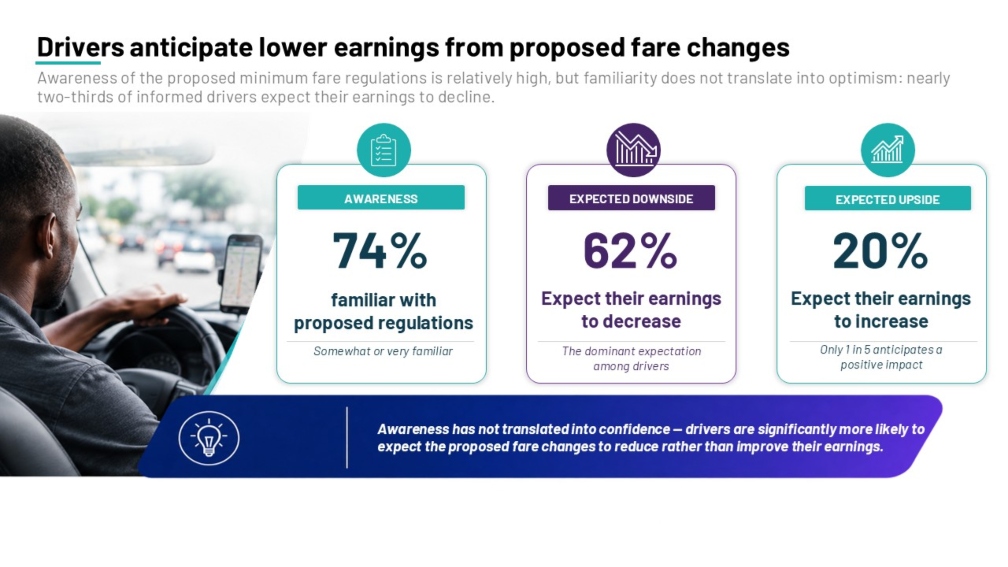
For many surveyed drivers, ride-hailing represents a significant source of livelihood. 65% said that 75% or more of their monthly income comes from ride-hailing, while 84% reported driving seven or more hours a day. When asked about the potential implications of higher fares, 57% of surveyed drivers said they expected fewer trip requests. Among drivers anticipating fewer requests, 65% believed this would reduce their overall monthly ride-hailing earnings.
The research also highlights a distinction between potential earnings per trip and anticipated overall earnings. While 34% of surveyed drivers identified higher earnings per trip as a potential impact of higher fares, only 17% expected their overall earnings to increase.
The ability to absorb a potential reduction in income also appears limited among those surveyed. 58% of drivers said finding another source of income would be difficult if their ride-hailing earnings dropped significantly. Safety and affordability both matter to passengers.
Bolt ride-hailing wins trust: 94% of Kenyans feel safer on app
The passenger findings indicate that price is one of several considerations when choosing a ride-hailing service. Safety was the leading consideration, cited by 49% of surveyed passengers among their top two factors. Affordability and reliability followed at 41% each, while convenience was cited by 40%. This suggests that riders assess ride-hailing based on a combination of affordability, safety, reliability and convenience, rather than price in
isolation.
When asked about their perceptions of the proposed higher minimum fares, 55% of surveyed passengers perceived the potential impact negatively, compared with 24% who
perceived it positively. The most identified concerns were that higher fares could make
ride-hailing less affordable, cited by 34%, and reduce access to transport, cited by 21%.
Research provides insight into passenger and driver expectations
Overall, the study provides insight into how surveyed passengers and drivers perceive potential fare changes and how they anticipate such changes could affect ride-hailing usage,
passenger demand and driver earnings.
The findings indicate a potential relationship between the different elements of the ride-hailing market: surveyed passengers reported that fare increases may influence how frequently they use ride-hailing, while surveyed drivers indicated that changes in passenger demand may, in turn, influence their overall earnings. These findings represent reported
expectations and perceptions and should not be interpreted as forecasts of actual future
market behavior.
“The research highlights the relationship between fares, passenger demand and driver
earnings within the ride-hailing market. Surveyed passengers, who had booked a trip
through a ride-hailing platform between June and August 2026, reported that fare changes may influence how frequently they use these services, while surveyed drivers indicated that
changes in demand may affect their earnings,” said Soyinka Witness, Director, Ipsos Kenya.